

Crunchbase Released the World’s Most Valuable Startups of 2026 And the List Tells You Everything About Where the Global Economy Is Heading
The Crunchbase Unicorn Board just published its June 2026 rankings and the top 20 most valuable private companies on earth tell a very specific story about where the next trillion-dollar company are.

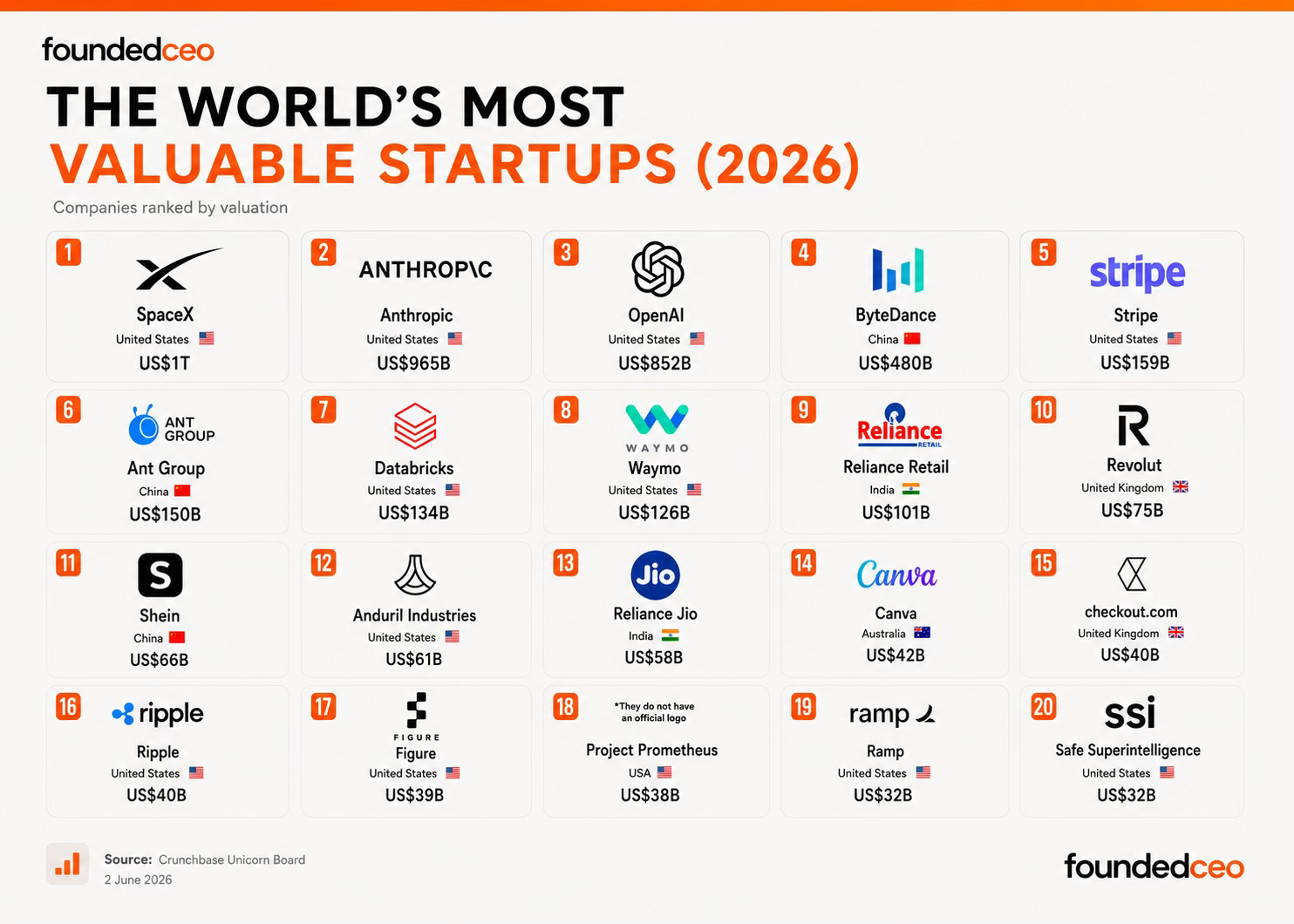
Every year, the Crunchbase Unicorn Board publishes the most comprehensive ranking of the world’s most valuable private companies, built from real funding round data across thousands of startups globally. The June 2026 edition just dropped, and the top 20 companies on the list represent a combined valuation that would make them collectively larger than every economy on earth except the United States and China. The list is is a map of where the most important value creation in the global economy is happening right now, and the patterns inside it are worth every founder’s and investor’s full attention.
The Top Four: A New Economic Hierarchy
SpaceX sits at #1 on the Crunchbase Unicorn Board with a valuation of $1.25 trillion following its merger with xAI, making it the most valuable private startup in the world by a significant margin. The $1 trillion valuation is the first time any private company has crossed that threshold in startup history, and the number reflects exactly what we covered when SpaceX pre-IPO futures opened on Hyperliquid at a $2.5 trillion implied valuation, capital markets have decided that SpaceX is sovereign-grade infrastructure, not an aerospace company, and the Crunchbase data confirms that institutional consensus has fully formed around that thesis.
Anthropic sits at #2 with a $965 billion valuation, OpenAI at #3 with $852 billion, and ByteDance at #4 with $480 billion. The top three positions going to American AI companies, with Anthropic at #2 above OpenAI at #3, is the most important signal in the entire ranking. As we covered when Anthropic entered talks to raise at $900 billion, that repricing reflected a fundamental shift in enterprise confidence from OpenAI to Anthropic that has now been confirmed by the Crunchbase data. Six months ago, OpenAI was the undisputed #1 in AI valuation. Today it sits below Anthropic by more than $100 billion.
The Infrastructure Layer: Stripe, Databricks, and Waymo
Below the top four, the next tier of the ranking is equally revealing. Stripe at #5 with $159 billion, Databricks at #7 with $134 billion, and Waymo at #8 with $126 billion together represent three of the most important infrastructure bets in the private market; payments, data, and autonomous transportation, and all three of them have been compounding toward these valuations for more than a decade of private market growth.
The US hosts many of the most valuable private startups globally, including SpaceX, Anthropic, OpenAI, Stripe at $159 billion, Databricks at $134 billion, and Waymo at $126 billion, which confirms that despite the rise of Chinese and Indian unicorns on the list, American companies still dominate the top of the global private market by a wide margin. Stripe’s $159 billion valuation for a company that processes payments for millions of businesses and has been building its financial infrastructure layer quietly for 15 years, is a reminder that the most durable companies on lists like this are rarely the ones generating the most headlines.
The Geopolitical Story: China and India on the Board
Four of the top 20 companies are Chinese or Indian, and the distribution of those four companies tells a specific story about where global private market value is concentrating outside the United States. ByteDance at #4 with $480 billion and Ant Group at #6 with $150 billion represent China’s two most valuable private companies; both of them operating under significant regulatory pressure from Beijing, both of them still commanding valuations that exceed every European private company combined. Shein at #11 with $66 billion rounds out the Chinese presence on the list.
India’s representation comes through Reliance Retail at #9 with $101 billion and Reliance Jio at #13 with $58 billion. Both subsidiaries of Mukesh Ambani’s Reliance Industries, and both reflecting India’s emergence as a genuine private market force in retail and telecommunications that the Silicon Valley ecosystem has historically underweighted. As of May 2026, there are 1,757 startup companies with a valuation of $1 billion or more globally, with the United States home to 900 of them (nearly half of the world’s total unicorns) followed by China, India, the UK, and several European countries.
The Ones Worth Watching: Anduril, Ramp, and Safe Superintelligence
Three companies in the bottom half of the top 20 deserve significantly more attention than their rankings suggest. Anduril Industries at #12 with $61 billion is the defense tech company founded by Palmer Luckey that has quietly become the most important private defense contractor in the United States, building AI-powered autonomous weapons systems for the Department of Defense at a speed and cost that traditional Lockheed and Raytheon contracts cannot match. The $61 billion valuation reflects the defense budget’s shift toward software-defined systems, and Anduril is the clearest private market beneficiary of that shift.
Ramp at #19 with $32 billion is the corporate finance platform that has grown from a spend management tool into a full-stack financial operating system for businesses, and its presence at $32 billion alongside companies like Waymo and Databricks confirms that the boring-but-critical financial infrastructure category continues to produce enormous private market value regardless of which AI cycle is generating the most headlines.
Safe Superintelligence at #20 with $32 billion is the one that deserves the most careful attention. Safe Superintelligence, co-founded by former OpenAI chief scientist Ilya Sutskever, has made the Crunchbase Unicorn Board alongside Project Prometheus as examples of the most significant early-stage unicorns of 2026, companies that have reached billion-dollar-plus valuations at unprecedented speed. SSI has raised over $2 billion in total funding with a single stated goal: building safe super-intelligence, with no product, no revenue, and no distraction from that mission. The fact that it sits at $32 billion confirms that the market is willing to pay frontier-lab premiums for the teams it believes are most likely to reach AGI first.
The Broader Picture: What This List Actually Tells You
Current unicorns have raised over $1.38 trillion in financing rounds and carry a total valuation of $8.6 trillion globally, with software, financial services, AI, cybersecurity, health tech, and data infrastructure remaining the top industries for unicorn formation. The top 20 on the Crunchbase list compress that $8.6 trillion picture into its most essential elements: AI infrastructure at the top, fintech and data in the middle, and a collection of defense tech, autonomous systems, and frontier AI labs in the lower tier that will almost certainly move up this ranking over the next 24 months.
A total of 47 seed and early-stage companies joined the unicorn ranks in Q1 2026 alone, putting 2026 on track to deliver the largest cohort of young unicorns ever recorded, with Project Prometheus joining the board as one of the year’s most significant new entrants. The pipeline feeding the top of this list is accelerating, not slowing, which means the companies that will define the 2027 and 2028 versions of this ranking are already being built right now, most likely by founders working in AI infrastructure, physical AI, defense tech, and healthcare.
Why it matters: The Crunchbase Unicorn Board is the most accurate real-time map of where private market capital believes the most durable value is being created. The June 2026 edition confirms three things that every founder and investor should internalize: AI has produced the three most valuable private companies in American history simultaneously, the infrastructure layer beneath AI (payments, data, autonomous systems) is compounding at a pace that the consumer layer cannot match, and the defense tech and frontier AI categories represent the fastest-growing segment of the top 20 by both count and aggregate valuation. The next trillion-dollar company is already on this list. The question is which number it’s sitting at right now.
The Takeaway: SpaceX crossed $1 trillion. Anthropic surpassed OpenAI. Anduril, Ramp, and Safe Superintelligence all broke into the top 20. The Crunchbase Unicorn Board as of June 2, 2026 is the clearest single-page summary of where the private market has placed its highest-conviction bets on the companies that will define the next decade of the global economy. Study it carefully.